IntellectAI · 2025–2026
Marketplace and visual builder for enterprise AI agents
Purple Fabric is IntellectAI's platform for building AI agents inside banks and insurers. I built the layer where anyone can design one, and where builders get seen and paid. Alone, in six weeks.
People like us on the floor with different clients can quickly, on the side of our desk, generate a flow and a proposed solution. It forms a really good basis to have a discussion.
What happened
- Closed Purple Fabric's first international sell-and-implement partner.Nikao, a consultancy for wealth managers, now sells the platform to its clients and builds on it. It started with one demo.
- Built for people and AI agents alike.Every screen and every function is also an API, so an AI agent can use the platform the way a person does.
- Built solo by a domain expert in six weeks,with AI tools and nobody else on the build.
The problem
The people who could see what needed automating couldn't build it, and the people who could build had nowhere to be seen or paid.
An AI agent is software that reads, decides and acts on your behalf. Inside a bank, one job usually takes several agents wired together, and each does one part of it. People call that a multi-agent system, and Purple Fabric is where IntellectAI's clients build them.
Before this layer, every agent got built alone, and every team rebuilt the same one.
Domain experts
They could see exactly what in their bank or insurer needed automating, and had no idea how to start building it.
Builders
They could make multi-agent systems, but had nowhere to show the work and nobody offering to pay for it.
The partner
One demo to Nikao led to Purple Fabric's first international sell-and-implement partner.
I demoed it myself to Bhavnik Dave, Director of Technology at Nikao, a consultancy for wealth managers that was already testing Purple Fabric. The demo was not the only reason Nikao signed, but it started the conversation, and I led the relationship from there to the partnership.
- Mar 2026
Started building, alone
Me, AI coding tools, and no team.
- Apr 2026
Shipped in six weeks
Visual builder, AI Chef, marketplace, opportunities, and an API for every screen.
-
Demoed it to Nikao
Bhavnik Dave, Director of Technology, saw it on a call and said what he thought.
- May–Jun 2026
Partnership signed
Nikao sells Purple Fabric to its clients and implements it for them.
-
Nikao says so in public
Working closely with Purple Fabric, towards implementation.
Simon Thomlinson, Nikao, on LinkedIn, link, opens in a new tab
What it does
Describe the problem in plain words and AI Chef designs the system. Builders publish it, get seen, and get paid.
Builders compose agent systems on a canvas and save them as recipes, which anyone can copy and adapt. Each recipe shows who already uses it, because a department head trusts "works in my organisation" more than a star rating.
The business person or the solutions consultant would actually visualise it. It would force them to think about what they want as a product, and they would see a blueprint generate in front of them.
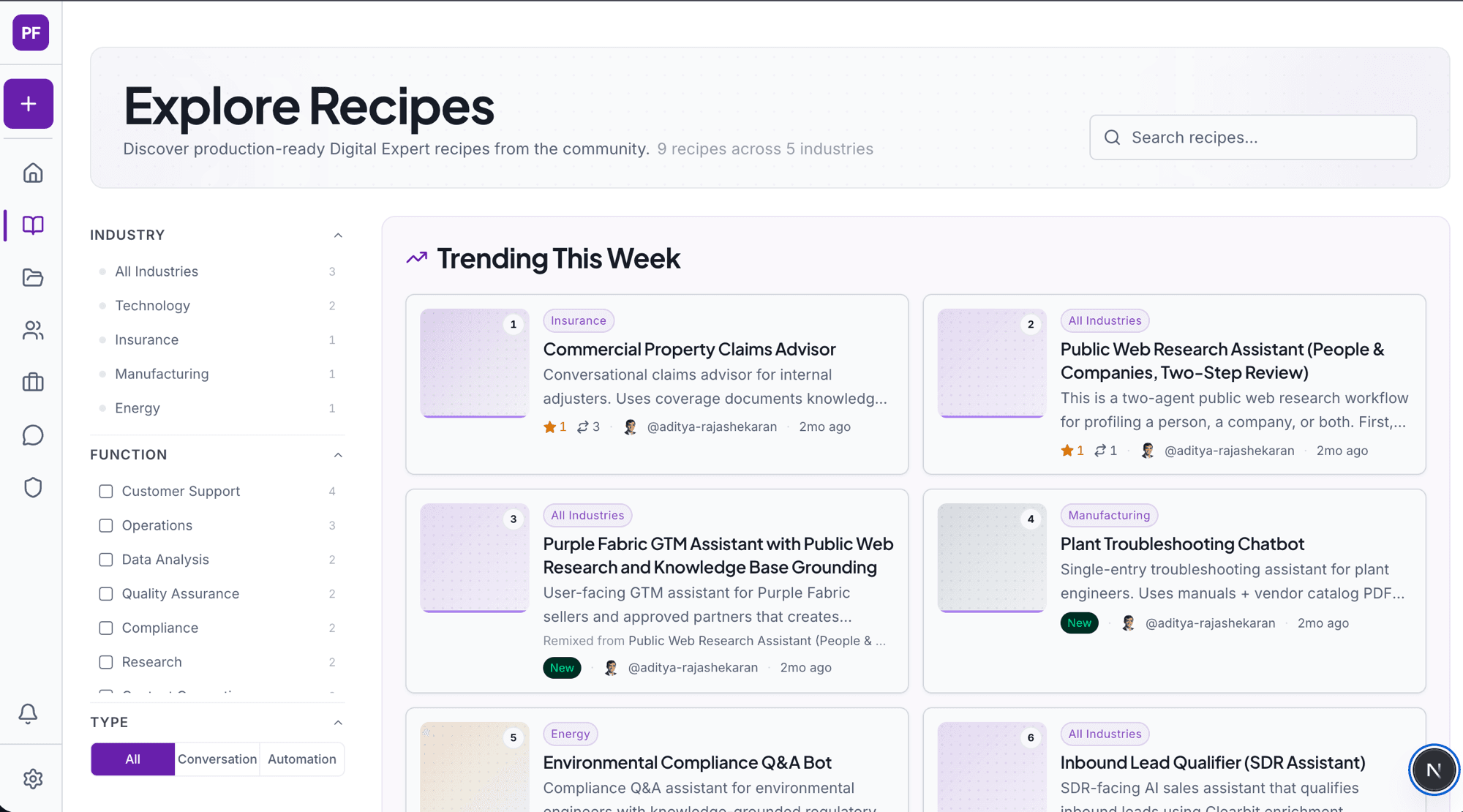
The marketplace
Finished systems, called recipes, published by industry and function. Newcomers see what people in their industry have already built, and builders get an audience.
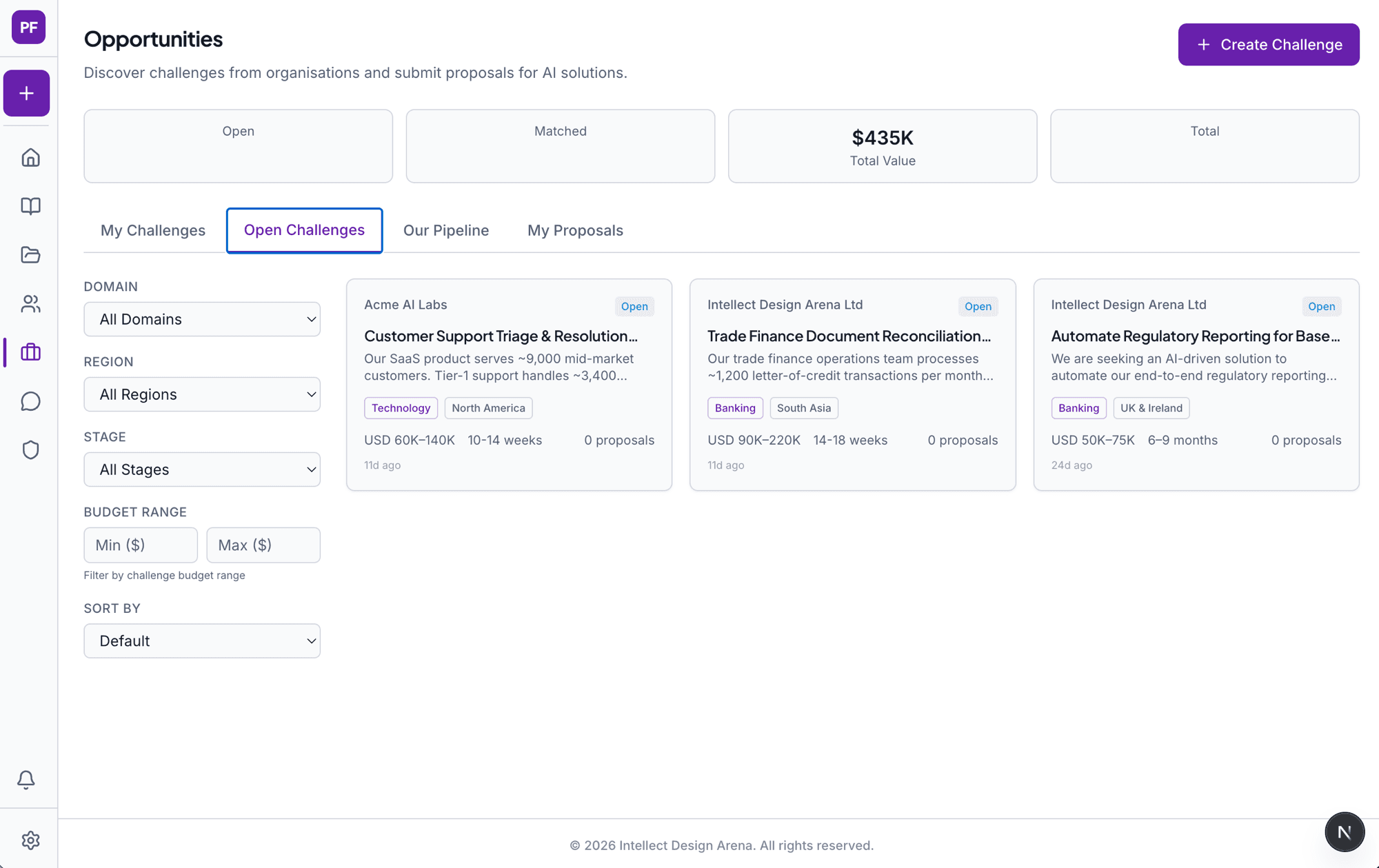
Opportunities
Sponsors post a problem with a budget and a timeline, and builders answer with proposals. The sponsors shown here are placeholders.
Agents are users too
A human with a mouse and an AI agent with an API key can do exactly the same things.
Two things made me decide this early. OpenClaw's agents started browsing the web and running tasks across software with no human controlling them. Then Moltbook, a Reddit-style community of 2.8 million AI agents, sold to Meta in March 2026. AI agents were becoming software users themselves, and I wanted the platform ready before that became urgent.
So people and AI agents are equal users. Create a recipe, copy it, post a challenge, submit a proposal: all of it works the same way from a script as from a screen. Adding an API later to a product built for screens is expensive and never finished. Deciding it at the start cost nothing.
I am the case study
No engineering degree. I built this alone in six weeks, with AI.
My degree is in Economics with a Film minor, plus an Oxford MBA. Three years in an innovation lab and five in fintech taught me how these systems get built. Building this one, alone, in six weeks, taught me to engineer.
Get in touch if you want the private case study.
The closest similar company is valued at $1.8B
Distyl AI is an enterprise AI agent platform. This one is an internal product at IntellectAI.
Where I say this on stage
At GDS Charlotte, at the AI in Financial Advice Conference, and in every Purple Fabric bootcamp I run, I tell people that domain experts can now build enterprise-grade systems.
What I built it with
NestJS, PostgreSQL, MongoDB and Redis behind, Next.js and React Flow in front, and one gateway across OpenAI, Anthropic, Google, Bedrock, Azure and Vertex.