Exhibit · 2025
Pattern & Prediction
An AI that learns you in fifteen rounds
Rock-paper-scissors looks like a game of pure chance. It isn't.
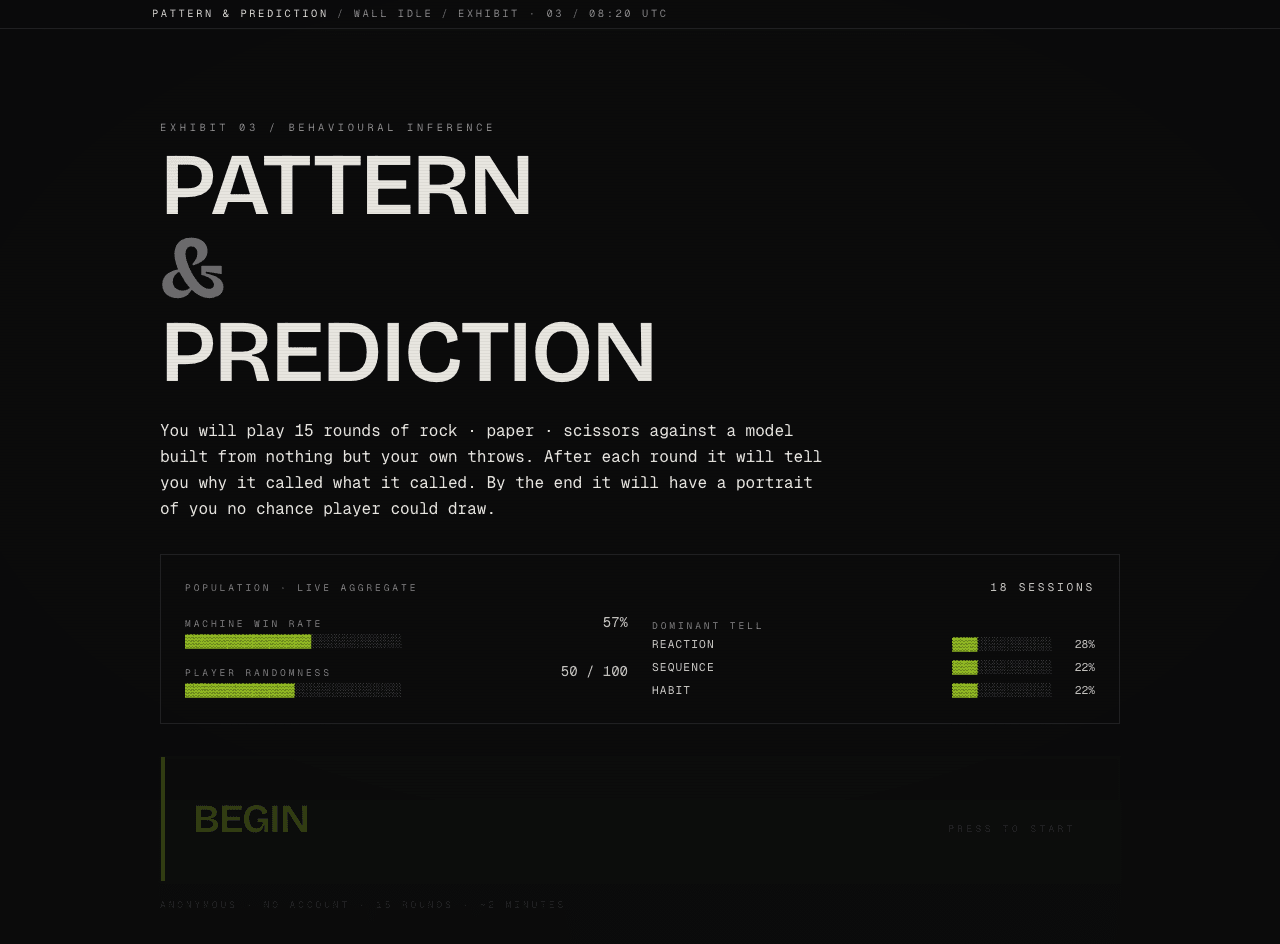
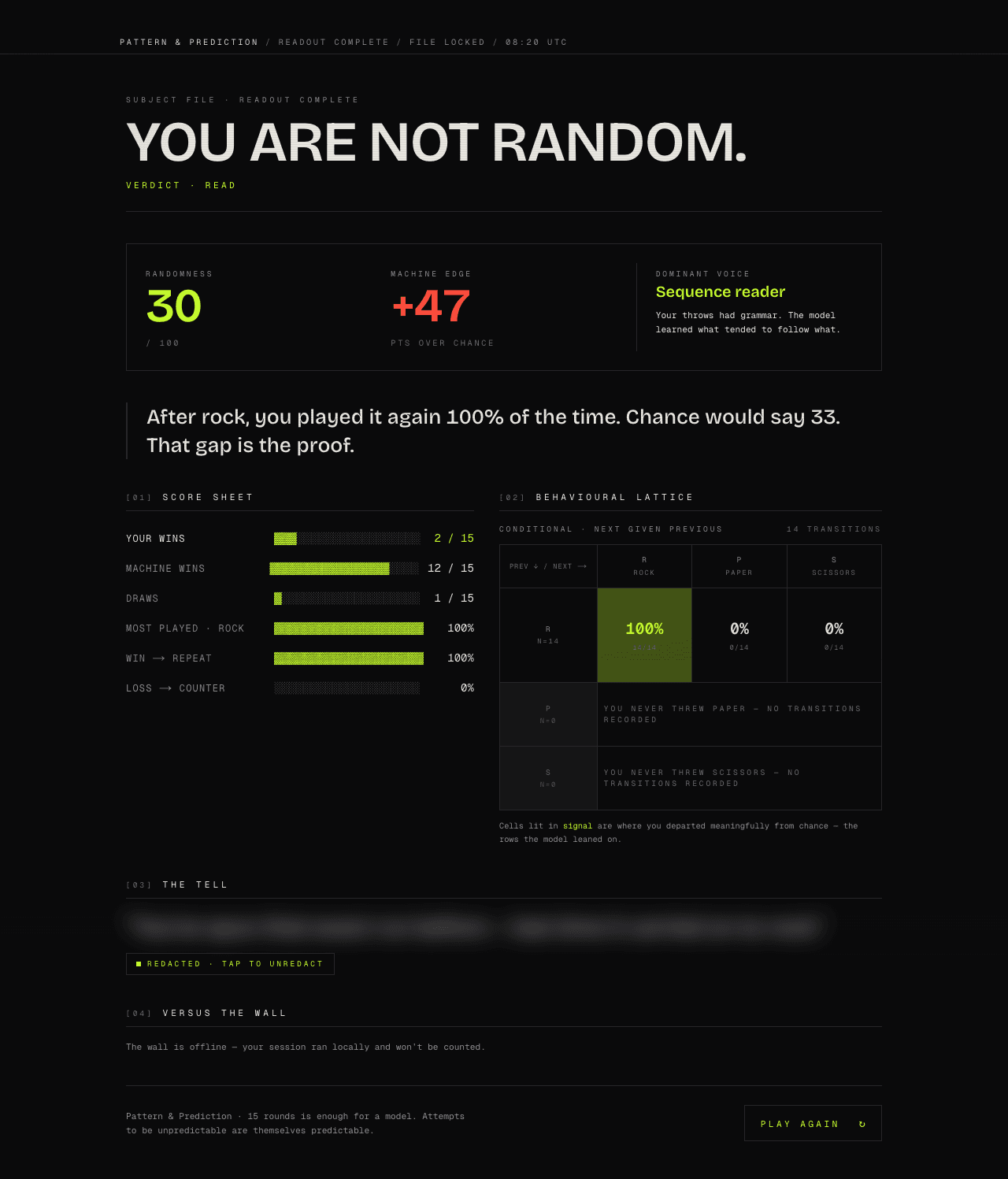
"Pattern & Prediction" is a generative-AI exhibit built in 2025. Visitors play rock-paper-scissors against an AI opponent that gets smarter about you with every round: your tendencies, your habits, the decisions you make when you're winning and when you're losing.
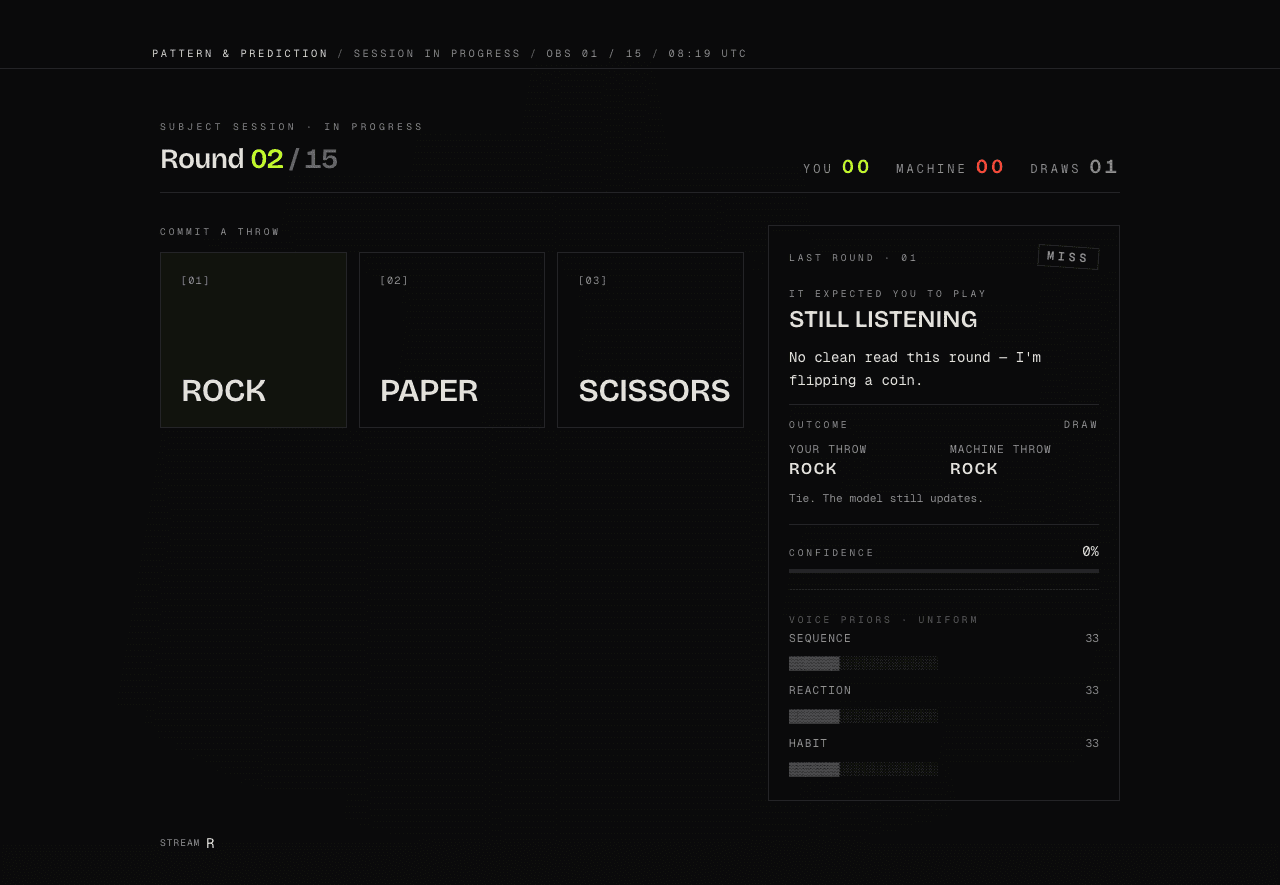
A stack of prediction engines runs underneath, each reading you from a different angle. One tracks sequences and asks whether this player tends to follow scissors with rock. Another watches win-stay/lose-shift (the unconscious tendency, which most players have and most players deny, to repeat a winning move or abandon a losing one). A third maps raw preference, the move you reach for under pressure. They roll up into three voices (Sequence, Reaction, and Habit) that watch every round, score themselves against you specifically, and vote on what you'll do next.
The result is an opponent that gets harder to beat the longer you play. That shift is the exhibit.
Visitors who open the internal-reasoning view can watch this happen in real time. Their moves become patterns. Patterns become probabilities. Probabilities become predictions. Most visitors try to beat the system by randomising: switching strategies, deliberately mixing up their choices. What they find is that the attempts to be unpredictable are themselves predictable. The system learns those too.
That's the moment the piece is after. Given enough data, an algorithm stops modelling the crowd and starts modelling you. The shadow self the exhibit describes is the model the system has built of you after fifteen rounds.
The meta-layer
Claude Code helped build the exhibit. That felt right. An AI system contributed to creating a work about AI systems learning from human behaviour. Claude Code suggested the ensemble architecture: the way dozens of strategies share information and re-weight each other's predictions based on how each has fared against this particular player. It shaped the idea as well as the code.
Working with it had the same texture the exhibit explores. I'd describe what I wanted; Claude Code would suggest directions I hadn't considered. The system took shape through that back-and-forth. Making it was part of understanding what it was about.
Technical notes
Under the hood it's a meta-strategy stack in the Iocaine Powder and Greenberg lineage: around thirteen base predictors, each expanded into six Iocaine variants for roughly seventy-eight strategies in all, every one scored against this specific player and re-weighted each round. A human prior makes it sharp from the first move. When nothing is actually beating chance it throws uniformly at random and admits it, so it never claims a pattern that isn't there. It's tuned against simulated players until it reliably beats a realistic visitor inside fifteen rounds.
The exhibit is live again at patternandprediction.horizonfall.com, now on Next.js and Supabase. It runs, though it isn't fully polished yet. The code is open source under the MIT license, so anyone who wants to run it, fork it, or take it further is welcome.